 |
 Here the desire of global tourism to consume Asian tropical exotica is satiated in the shrewd complicity of a sumptuous architecture refined to a 'tropical resort' system that is easily adaptable regionally. Paradoxically, their strategy may secretly carry new architectural values along with what global tourism, or global capital wants. |
||
 |
|||
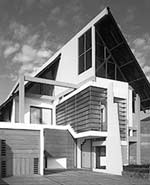 But not all hanker for a controlled, unified Gesamptkunstwerk. Sardjono Sani in Jakarta, for instance, deliberately installs a contaminative strain from local ethnic Chinese fengshui principles to defy the perfection of the modern architectural body. On a lot that faces a T-junction, Sani's NO-BODY HOUSE twists and skews in complex geometries derived from a clash between the 'qi' or force from the T-junction, somehow allowed to flow into the house; and the static rational modern response to the site. The universal modern thus is inflected by the local belief, the rational by the arational, albeit in a suspiciously deconstructivist way; representing the complex re-negotiations that is happening to that city..
These voices discussed here are only some of the many diverse voices poised to further extend the debate beyond established "battle" lines of identity politics constructed in Asia. They have a chance to speak in their own unaffected ways towards new different modern architectural traditions.
NOTES i Alan Colquhoun, "The Concept of Regionalism" in Gulsum Nalbantoglu and Wong C. T. eds., postcolonial space(s) (The Princeton Architectural Press, 1997):18 ii Ibid.: 20 iii Leon van Schaik, "Between Abstraction and Cultural Reference" published in Singapore Architect #201 1999, KokMeng Tan. <-- previous <<--------------start it over Comments?, opinions? email to Kok Meng Tan @ guoming@pacific.net.sg or webmaster@art4d.com |
|||
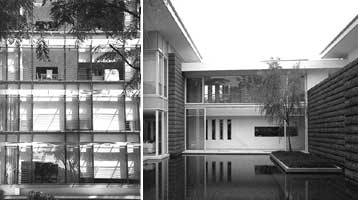 The negotiations between tradition and modern, is infinitely more harmonious and more embodied in the case of Mok Wei Wei's House at Morley Road. As pointed out by Leon van Schaik in his review of this work, a traditional Chinese sense of progression and arrangement of space is incorporated subconsciously within the abstract modernism architectural language of points, lines and planes. Boundaries between the interior and the exterior are blurred, simultaneously to identify both with the sense of living in the tropics and the feeling of being in a traditional landscape garden. In another project, a block of expensive apartments in the city, the strategy to dissolve the interior and the exterior is carried to its ultimate conclusion by having the entire façade in glass. The artificial urban landscape of the city now replaces, redefines the manicured, artificial Chinese landscape garden.
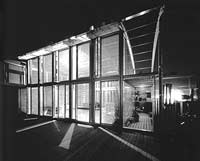 Overt cultural identity in predominently ethnic Chinese Taiwan, is abandoned in the work of Hu Shyr Fung. His own house in Tai Chung is designed to express rational structure and modular construction and a visibly logical way of putting things together. Instead of responding to local specificities, it is based conceptually on an idealised notion of a modern house. Intending towards a prototype, his architecture relies on an abstract architectural language of textures and layering to define in his words "levels of privacy, sense of ambiguity and suspense." Tautologically, the modern architecture language is accepted unquestioningly, but towards an end that may serve his "Asian" sensibility of working with subtle transitions.
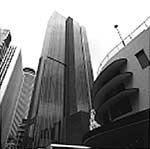 In a similar way, Hong Kong's identity has shifted away from ethic, cultural references to embrace its existing urban condition. Its huge colourful neon signs bridging across busy streets, graphic festooned double-decker buses, skyscrapers and congested skyline are what most would identify Hong Kong the city, with. OMA Asia's efforts for a 40-storey office tower in HongKong SAR, the CEF Life Tower, is in the design of a taut blue reflective curtain-walled skin with vertical aluminium mullions. It emphasises the aesthetics of extremely condensed verticality found and often theorised in the city. Providing a column-free office space, its form is almost a direct extrusion of the allowable building shape after statutory setbacks, recounting the logic of free-market capitalism that still governs the city.