 |
 The globalised economic network thrives in places without identities, without specific qualities. But sometimes old structures and old systems still remain vital in the host city. This is the case in Bangkok - a truly layered urban terrain of multiple ideologies, organisations, systems and imageries; each tolerated, and accommodated, without hierarchy, save for the monarchical order, which all show deference to. |
||
 |
|||
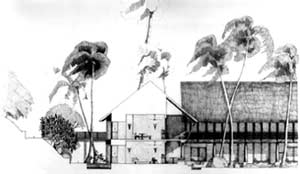
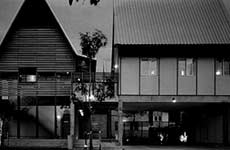 A residential work by Thai architect, Kanika Rattanapreedakul in a suburb of Bangkok named HOUSE U3 embodies this tolerant intermeshing and refuses an either/or solution. Coming back to Asia from her education at SCIARC, California, she already embodies the hybridity of a number of the polar opposites: east and west; modern and traditional; redefined confidence in a male-dominated society and architectural community. The roof form is a direct quotation of the canonised traditional Thai house, but now in corrugated metal instead of clay shingles. It sits on a reinforced concrete frame construction of similar proportion to the Thai house. Everywhere else detailing and tectonics are emphasised as in craft-based Thai building tradition, albeit in a 'contemporary' way. On plan, this house folds into a 'U' that programmatically is actually three discrete homes: for her parents, her sister and herself. Thus the programme modifies the architecture but still keeps the organisational rules set up by it. Therefore what started out as a formal adoption of tradition, becomes modified by a modern sensibility in its construction and further modified by a present-day family structure. The notion of identity is more fluid here, morphing from one to another easily throughout the house, but still conforming to the rules and principles laid down by seemingly opposed building traditions, received indigenous and educated modern but united by the confluence of tectonic expressiveness.
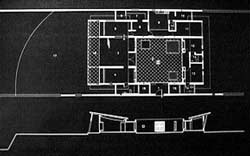 In the work of Bombay architect Rahul Mehrotra on the other hand, indigenous building traditions are appropriated to fabricate new modern forms. Specific cultural spatial character is invoked in an abstract manner, in order to be incorporated into modern architectonic gestures. Shanti - a weekend house in Alibag features a high long wall built with locally quarried rocks that literally grounds the work to its specific locality. But it is nevertheless an abstract wall, a modern element that begins to structure the rest of the house, forming an intimate courtyard, framing views out towards the sprawling landscape. The impulse of Mehrotra, has a somewhat legitimate legacy in Correa and Doshi. But arguably it goes beyond theirs, in the sense that the work relies on the transgression of one identity over the other to give it its value.
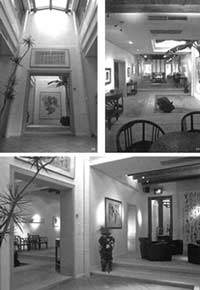 This is slightly different from the work of Richard Ho, a Singapore architect. Ho's strength and interest in the evocation of local architectural character, is quite specifically spatial and in terms of materials used. The construction methods remain modern. The typologies of the Singapore which he grew up in; that is, the long and narrow shophouses with vertical lightwells, anglo-indian style colonial bungalows on stilts, and the early modernist white art-deco buildings with horizontal sunshading fins; represent what the history of place is to him. Always reacting strongly against the prevailing penchant for the erasure of existing urban fabric in this city, Ho makes it his personal politics to show up the qualities of the existing, of the importance of preserving memory in the face of rapid change. His best work to date is also the most subtle: in the Cicada Gallery - the existing shophouse space is stripped bare, reducing all new intrusions visually to a minimum in order to have maximum, unadulterated experience of the essential qualities of the shophouse. Materials used make direct references to those found in old shophouses, but here detailed in a sharp, 'modern' way. This minimisation is a significant act that runs counter to the prevalent instrumental thematisation of the old, existing fabric by many Singaporean conservationists and preservationists.
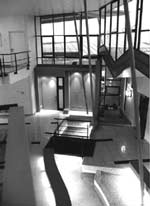 For Frank Ling and Pilar Gonzalez-Herraiz of Architron based in Kuala Lumpur, the conservation of vernacular typologies is taken not quite literally but rather recur as resonances in their work. Operating in the same context as Caesar Pelli's Petronas Twin Towers, where the nation's Islamic identity is ostentatiously worked into their formal ordering, the resistance to conspicuous references to local identity makes their work even more critical. What is evoked in their Dialogue House, situated along the ambitious Multi Media Super Corridor, is the still vital relation between internal spaces and the external spaces in the domestic conditions of local everyday lives. Being in the tropics, many in Kuala Lumpur enact their lives according to the changing patterns of hot and glare, cool and shade, afternoons and evenings, throughout the day. In this work, the exterior is recreated artificially inside as a lofty space that lets in air and light. It even constructs an artificial river that runs through it. Rooms become little houses that open out toward this man-made landscape. Considering that this house sits on an artificially demarcated speculative plot facing a new golf course, another man-made landscape, this strategy is highly polemical, instead of being overtly about recuperating established identities.
 If Architron limits their invention of an artificial landscape to the interior, WOHA of Singapore made up of Wong Munn Summ and Richard Hassell, extend theirs beyond the inside right up to where the obsessive need to control the visual environment is stopped only by statutory boundaries. In their work, the entire experience through it is choreographed and plotted meticulously with a heavy emphasis on aestheticism, wrought through sensuous materials and refined detailing. In a project for a resort on an island off Mersing, their fixation with things beautiful (in the visual chaos of urban Asia?) find catharsis in reinventing a generic resort for the tropics.
next---- >> <-- previous |
|||